

Did you know that over 600 million products bear the CE marking in Europe every year ? For airsoft enthusiasts, this symbol is far from insignificant. It plays a key role in their safety and their freedom to choose reliable equipment. Understanding the requirements behind this standard provides concrete guidelines for buying, playing, and equipping yourself with confidence on the field.
Table of Contents
- Definition and objectives of the CE airsoft standard
- Safety requirements for airsoft equipment
- CE marking and certification process
- Legal consequences of non-compliance with the standard
- Comparison with other safety standards
Key Points
| Point | Details |
|---|---|
| CE marking | The CE marking is a regulatory element indicating the conformity of airsoft equipment to European directives. |
| Safety requirements | The equipment must comply with strict safety standards, particularly for eye protection certified to EN166B or EN166A. |
| marking process | Manufacturers must go through a rigorous testing and evaluation process before they can affix the CE marking. |
| Legal consequences | Failure to comply with CE standards may result in legal penalties, including fines and product withdrawal from the market. |
Definition and objectives of the CE airsoft standard
The CE marking is a crucial regulatory element in the field of airsoft equipment, representing much more than a simple sticker. According to official sources, this marking formally indicates that a product complies with the essential requirements defined by European directives, allowing its free movement within the European Economic Area.
Contrary to popular belief, the CE marking is not a quality certification but a regulatory marking that authorizes the circulation of products covered by European regulations. For airsoft equipment, this means that protective gear, accessories, and equipment meet specific safety and performance standards.
The main objectives of CE marking in the context of airsoft are multiple:
- Ensuring user safety
- Standardize equipment at the European level
- Facilitating the movement of goods between member countries
- To ensure a minimum level of protection and quality
For airsoft enthusiasts, understanding ballistic protection standards allows them to choose compliant and safe equipment for their tactical activities.
Safety requirements for airsoft equipment
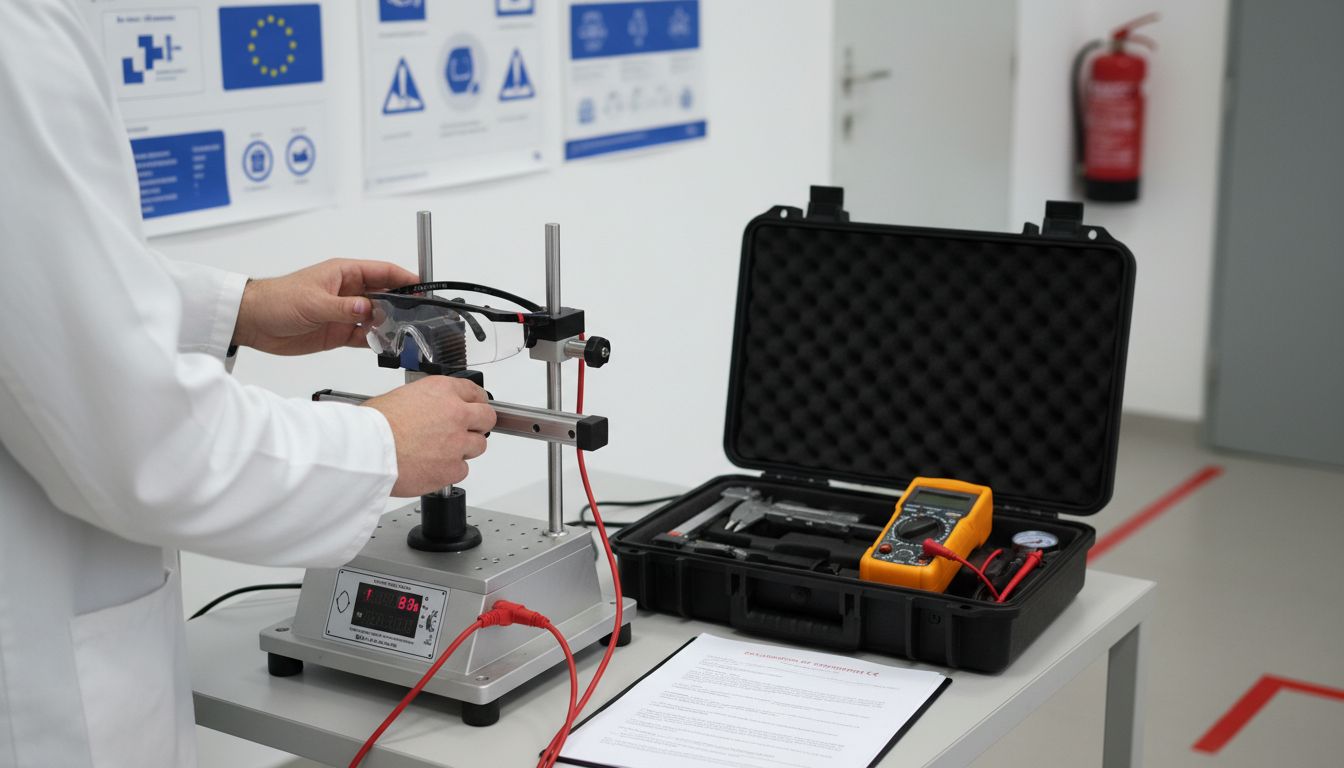
Airsoft equipment must meet strict safety standards , especially personal protective equipment, which is essential during games. Eye protection is the most critical example of these regulatory requirements, with precise technical specifications guaranteeing player safety.
According to the French Airsoft Federation, eye protection must comply with the EN 166 standard, with a minimum mechanical resistance of level B or A. This standard ensures adequate protection against BB impacts during games, preventing the risk of serious injury.
The main safety requirements for airsoft equipment include:
Here is a summary of the main safety requirements for airsoft equipment:
| Requirement | Short description | Associated standard |
|---|---|---|
| Eye protection | Certified, impact-resistant glasses | EN166B or EN166A |
| Durable materials | Shock-absorbing materials | EN166 |
| Blanket | Complete eye protection | EN166 |
| Stability | Optimal support during use | EN166 |
| Compatibility | Use in combination with other protective equipment | EN166 |
- EN166B or EN166A certified eye protection
- Materials resistant to ball impacts
- Complete coverage of the eye area
- Stability and optimal support during activity
- Compatibility with other protective equipment
To deepen your understanding, consult our comprehensive guide to protective equipment which details the essential safety standards to be respected when practicing airsoft.
CE marking and certification process
The CE marking process for airsoft equipment is a complex regulatory process that requires meticulous attention from manufacturers. Before they can affix this official marking, producers must carry out a series of rigorous checks and tests guaranteeing that their products fully comply with European requirements.
According to official sources, the CE marking must be affixed by the manufacturer before any product is placed on the market. This process involves a detailed evaluation that includes not only technical tests, but also a thorough verification of compliance with European directives specific to protective equipment.
The key steps in the CE marking process are:
- Performing technical compliance tests
- Preparation of technical documentation
- Product-specific risk assessment
- Drafting the EC declaration of conformity
- Affixing the CE marking to the product
- Retention of compliance documents
To fully understand the technical intricacies of these standards, consult our ballistic protection guide which details the regulatory requirements for airsoft equipment.
Legal consequences of non-compliance with the standard
Failure to comply with CE standards in the airsoft sector can lead to significant legal and financial consequences for manufacturers, importers, and distributors. These sanctions aim to guarantee user safety and the integrity of the European market for sports and recreational equipment.
The legal risks associated with non-compliance are numerous and can directly impact a company's business. Regulatory authorities can immediately withdraw products from the market, impose substantial fines, and initiate legal proceedings against offenders who fail to comply with European regulatory requirements.
The main legal consequences include:
- Ban on marketing non-compliant products
- Potentially high administrative fines
- Suspension or withdrawal of sales authorizations
- Criminal liability in case of harm caused
- Obligation to recall and destroy non-compliant products
- Possibility of legal action by the authorities or the victims
To better understand the legal and technical implications, consult our comprehensive guide to protective equipment which details the essential safety standards to be respected in the field of airsoft.
Comparison with other safety standards
The CE standard in the field of airsoft differs significantly from other safety standards due to its comprehensive European regulatory approach. Unlike specific national standards, it offers a harmonized framework that guarantees a uniform level of safety for all equipment circulating within the European Economic Area.
Compared to international standards such as ISO standards or military regulations, the CE standard has the advantage of being more accessible and better suited to recreational activities. It takes into account the specific characteristics of tactical simulation sports while maintaining rigorous safety requirements, without imposing the extremely strict constraints of professional military equipment.
Main differences compared to other standards:
- European geographical scope
- Harmonised and standardised approach
- Flexibility suitable for recreational use
- Simplified certification process
- Lower compliance costs
- Mutual recognition between European countries
To deepen your understanding of the technical subtleties, consult our ballistic protection guide which details the regulatory nuances specific to airsoft.
Protect yourself with CE-compliant equipment to play safely
Understanding CE marking requirements in airsoft is essential to avoid risks associated with non-compliant protective gear. As a player, you primarily seek reliable equipment that ensures your safety while meeting mandatory European standards. Don't risk breaking the immersion or compromising your physical well-being with unsafe equipment.
Discover our wide selection of airsoft equipment designed to meet CE standards and ballistic protection.
Take action now and equip yourself from our collections of tactical helmets, as well as specialized clothing and apparel, at https://www.bdu-airsoft.fr to benefit from quality, compliance, and the best deals. Play with confidence and respect the regulations to fully enjoy your airsoft games!
Frequently Asked Questions
What is CE marking for airsoft equipment?
The CE marking indicates that airsoft products meet the essential requirements of European directives, guaranteeing their safety and performance for free movement within the European Economic Area.
What are the safety requirements for eye protection in airsoft?
Eye protection must comply with EN 166, with a minimum mechanical resistance of level B or A to ensure adequate protection against impacts from balls.
What are the legal risks if an airsoft product does not comply with the CE standard?
Failure to comply with CE standards can lead to marketing bans, fines, legal proceedings, and even the obligation to recall and destroy non-compliant products.
How does the process of obtaining CE marking for airsoft equipment work?
The process includes technical conformity testing, drafting a CE declaration of conformity, and affixing the CE marking to the product once all requirements are met.


